Helping Users Fast-Track Their Career Growth
Helping Users Fast-Track Their Career Growth
3rd place in a national AI equity design challenge 🏆 Designed a browser-based experience that helps users understand skill gaps and take action
3rd place in a national AI equity design challenge 🏆 Designed a browser-based experience that helps users understand skill gaps and take action
Type
National AI Equity Design Challenge
National AI Equity Design Challenge
Timeframe
Sep 2025 - Dec 2025
Sep 2025 - Dec 2025
My Role
UX Researcher & UX Designer
UX Researcher & UX Designer
Team
4 UX Designers: collaborated on research, and end-to-end design
4 UX Designers: collaborated on research, and end-to-end design
About This Project
🏆 3rd place out of 86 teams across Canada in the TECHNATION AI Equity Data Challenge
A human-centered, data-informed design project exploring AI equity and career transition uncertainty
Combined labour market data analysis with qualitative interviews to understand how people experience AI-driven change in their careers
Why It Matters
As AI reshapes the job market, some roles in law and healthcare are beginning to benefit, while many mid-career workers in finance, tech, and service roles face increasing uncertainty
Users struggle to identify transferable skills, realistic pathways, and actionable next steps
This project supports career progression and transition by clarifying options, highlighting skill gaps, and offering practical guidance through a browser-based experience
The tool functions as an extension to fit naturally into daily routines and help users move forward with confidence
About This Project
🏆 3rd place out of 86 teams across Canada in the TECHNATION AI Equity Data Challenge
A human-centered, data-informed design project exploring AI equity and career transition uncertainty
Combined labour market data analysis with qualitative interviews to understand how people experience AI-driven change in their careers
Why It Matters
As AI reshapes the job market, some roles in law and healthcare are beginning to benefit, while many mid-career workers in finance, tech, and service roles face increasing uncertainty
Users struggle to identify transferable skills, realistic pathways, and actionable next steps
This project supports career progression and transition by clarifying options, highlighting skill gaps, and offering practical guidance through a browser-based experience
The tool functions as an extension to fit naturally into daily routines and help users move forward with confidence
Our 4-Step Design Process: Bridging Data and Design
Our 4-Step Design Process: Bridging Data and Design
Our 4-Step Design Process: Bridging Data and Design
Step 1: Understanding Who Benefits from AI and Who Is Left Behind
Step 1: Understanding Who Benefits from AI and Who Is Left Behind
We documented Canadian labour market data in Excel and visualized key datasets through charts to identify AI-impacted roles and trends.
We documented Canadian labour market data in Excel and visualized key datasets through charts to identify AI-impacted roles and trends.

Collected and documented Canadian labour market data using Excel
Collected and documented Canadian labour market data using Excel

Reviewed overall employment trends across Canada and explored demographic differences by gender, visible minority status, and income
Reviewed overall employment trends across Canada and explored demographic differences by gender, visible minority status, and income

Analyzed industry employment trends alongside AI occupational exposure, complementarity, and job outlook
Analyzed industry employment trends alongside AI occupational exposure, complementarity, and job outlook
So, Who Benefits from AI, and Who Is Left Behind?
So, Who Benefits from AI, and Who Is Left Behind?
🟢 Who Benefits
High-Complementarity Roles
• Law- and healthcare-related roles (e.g., law clerks, registered nurses)
• AI augments efficiency and decision-making rather than replacing human labour
🟢 Who Benefits
High-Complementarity Roles
• Law- and healthcare-related roles (e.g., law clerks, registered nurses)
• AI augments efficiency and decision-making rather than replacing human labour
🔴 Who Is Left Behind
Mid-Career Workers (ages 25–54)
• Experienced, but require reskilling to remain relevant
Finance & Tech Professionals
• Strong wages today, but increasing long-term automation risk
Stable Low-Wage Workers
• Roles such as custodians, waiters/waitresses, and hotel clerks
• Relatively secure from AI automation, but limited wage growth
Service & Support Roles
• Cashiers, office workers, customer service representatives
• Limited-to-moderate job outlooks with higher automation risk
🔴 Who Is Left Behind
Mid-Career Workers (ages 25–54)
• Experienced, but require reskilling to remain relevant
Finance & Tech Professionals
• Strong wages today, but increasing long-term automation risk
Stable Low-Wage Workers
• Roles such as custodians, waiters/waitresses, and hotel clerks
• Relatively secure from AI automation, but limited wage growth
Service & Support Roles
• Cashiers, office workers, customer service representatives
• Limited-to-moderate job outlooks with higher automation risk
Step 2: From Quantitative to Qualitative: Listening to Lived Experiences
Step 2: From Quantitative to Qualitative: Listening to Lived Experiences
To move beyond trends and design around real needs, we interviewed 5 participants from roles identified in our data analysis, ensuring representation from mid-career workers (ages 25–54) across:
Healthcare (nurses)
Finance or tech-related roles
Stable low-wage roles
Service and support roles
To move beyond trends and design around real needs, we interviewed 5 participants from roles identified in our data analysis, ensuring representation from mid-career workers (ages 25–54) across:
Healthcare (nurses)
Finance or tech-related roles
Stable low-wage roles
Service and support roles
We guided our conversations to explore participants’ career paths across different stages, including skill development, reskilling experiences and challenges, and how technology fits into both their work and daily lives. This helped us better understand how ongoing technological change affects people across different roles and career stages.
We guided our conversations to explore participants’ career paths across different stages, including skill development, reskilling experiences and challenges, and how technology fits into both their work and daily lives. This helped us better understand how ongoing technological change affects people across different roles and career stages.
What We Discovered?
What We Discovered?
Insight 1: Competitive salaries and peer recommendations motivate people to pursue specific career paths
Insight 1: Competitive salaries and peer recommendations motivate people to pursue specific career paths

Participant 2 (P2)
P2 chose Software Engineering primarily due to its high-paying potential.

Participant 1 (P1)
Because several of P1’s relatives are nurses and recommended the profession, P1 decided to study nursing.
Insight 2: Participants primarily learn through two approaches: formal education and self-directed learning
Insight 2: Participants primarily learn through two approaches: formal education and self-directed learning

Participant 1 (P1)
P1
Most of the skills were learned and developed at school.

Participant 2 (P2)
P2
Develop skills through self-directed learning using YouTube and online resources.

Participant 5 (P5)
P5
I took some LinkedIn Learning courses on data analysis because I saw a lot of jobs asking for that.
Insight 3: Job availability plays a key role in career decisions, often outweighing personal career preferences
Insight 3: Job availability plays a key role in career decisions, often outweighing personal career preferences

Participant 3 (P3)
P3
Restaurant waiter/waitress roles have a high number of vacancies, giving P3 more opportunities to find employment.

Participant 3 (P3)
P3
P3 prefers an office-based role and does not enjoy customer-facing work.

Participant 1 (P1)
P1
P1 chose the department because the hospital only had openings in certain departments.
Insight 4: Some participants are considering career transitions but feel uncertain about how to begin
Insight 4: Some participants are considering career transitions but feel uncertain about how to begin

Participant 5 (P5)
“Feeling like I'm stuck. I'm good at my job, but there's no clear path forward.”

Participant 2 (P2)
After seven years in the industry, wants to pursue something more interesting.
Insight 5: Adapting to new environments and workplace cultures is one of the biggest challenges
Insight 5: Adapting to new environments and workplace cultures is one of the biggest challenges

Participant 1 (P1)
The most challenging time was adapting to a new environment, learning the culture there and understanding how things are done in a new ward.

Participant 3 (P3)
Learning new rules and environments is the biggest challenge for P3 when changing careers.
Step 3: Brainstorming & Concept Sketching
Based on interview insights, we defined our target users as people across different career stages who are seeking either career transitions or growth within their current roles. We conducted competitive analysis to identify gaps in existing solutions, then brainstormed and sketched multiple ideas to explore how these needs could be addressed. Through this process, we refined our thinking and aligned on a clear product concept and overall experience.
Based on interview insights, we defined our target users as people across different career stages who are seeking either career transitions or growth within their current roles. We conducted competitive analysis to identify gaps in existing solutions, then brainstormed and sketched multiple ideas to explore how these needs could be addressed. Through this process, we refined our thinking and aligned on a clear product concept and overall experience.
From Insights to Design Features
After brainstorming different ideas, we aligned on three shared design priorities. Each design feature was intentionally grounded in specific interview insights, ensuring that our solutions directly addressed real user motivations, uncertainties, and challenges. These became our core design features and guided the development of the final product.
After brainstorming different ideas, we aligned on three shared design priorities. Each design feature was intentionally grounded in specific interview insights, ensuring that our solutions directly addressed real user motivations, uncertainties, and challenges. These became our core design features and guided the development of the final product.
Design Feature 1: Understanding Job Availability
Show salary data and real employee insights
Provide job vacancy forecasts for the coming years
Helps users explore, compare, and understand career options when making decisions
Addresses:
Insight 1: Competitive salaries and recommendations motivate career choices
Insight 3: Job availability strongly shapes career decisions
Design Feature 1: Understanding Job Availability
Show salary data and real employee insights
Provide job vacancy forecasts for the coming years
Helps users explore, compare, and understand career options when making decisions
Addresses:
Insight 1: Competitive salaries and recommendations motivate career choices
Insight 3: Job availability strongly shapes career decisions
Design Feature 2: Preparing for Career Transitions
Introduce an AI-supported tool with formal training modules
Supports users in building confidence and preparing for career changes
Reduces the gap between learning and real work environments
Addresses:
Insight 2: Learning happens through formal and self-directed approaches
Insight 4: Uncertainty around where to begin when transitioning careers
Insight 5: Adapting to new environments and workplace cultures is a major challenge
Design Feature 2: Preparing for Career Transitions
Introduce an AI-supported tool with formal training modules
Supports users in building confidence and preparing for career changes
Reduces the gap between learning and real work environments
Addresses:
Insight 2: Learning happens through formal and self-directed approaches
Insight 4: Uncertainty around where to begin when transitioning careers
Insight 5: Adapting to new environments and workplace cultures is a major challenge
Design Feature 3: Personalized Guidance by Experience Level
Offer tailored materials, training, and next steps based on experience level
Designed for users who are new, familiar, or experienced in a field
Provides step-by-step guidance that is easy to follow
Addresses:
Insight 2: Learning happens through formal and self-directed approaches
Insight 4: Uncertainty around where to begin when transitioning careers
Design Feature 3: Personalized Guidance by Experience Level
Offer tailored materials, training, and next steps based on experience level
Designed for users who are new, familiar, or experienced in a field
Provides step-by-step guidance that is easy to follow
Addresses:
Insight 2: Learning happens through formal and self-directed approaches
Insight 4: Uncertainty around where to begin when transitioning careers

Journey Map
Helped us consolidate target users’ needs and visualize decision-making across key stages of the experience.
Journey Map
Helped us consolidate target users’ needs and visualize decision-making across key stages of the experience.
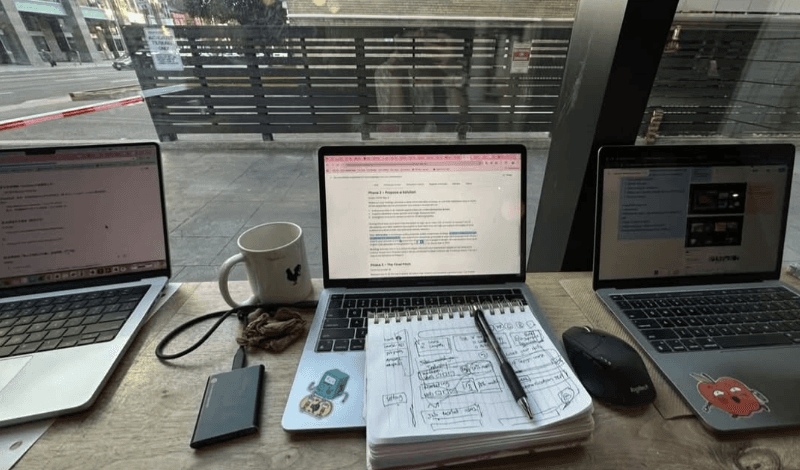
Team Discussions & Sketches
Supported competitive analysis and early concept sketching, helping the team align on opportunities and narrow directions.
Team Discussions & Sketches
Supported competitive analysis and early concept sketching, helping the team align on opportunities and narrow directions.

Paper Prototypes
Enabled quick validation of core ideas and user flows before moving into wireframes.
Paper Prototypes
Enabled quick validation of core ideas and user flows before moving into wireframes.
Step 4: Final Delivery - From Insights to Prototype
Based on our brainstorming, sketching, and team discussions, we designed Otters, a browser extension that keeps workers connected to their career goals from the moment they open their computer. We intentionally placed the experience on the new-tab and search pages so users can stay aware of progress and opportunities as part of their daily routine.
Every time users open a new tab or search on Google, Otters surfaces:
Career and learning progress
In-demand skills by industry
Personalized learning recommendations
The latest trends in their career field
By making career information visible and actionable in everyday moments, Otters encourages continuous learning and supports users in progressing toward their career goals.
Based on our brainstorming, sketching, and team discussions, we designed Otters, a browser extension that keeps workers connected to their career goals from the moment they open their computer. We intentionally placed the experience on the new-tab and search pages so users can stay aware of progress and opportunities as part of their daily routine.
Every time users open a new tab or search on Google, Otters surfaces:
Career and learning progress
In-demand skills by industry
Personalized learning recommendations
The latest trends in their career field
By making career information visible and actionable in everyday moments, Otters encourages continuous learning and supports users in progressing toward their career goals.
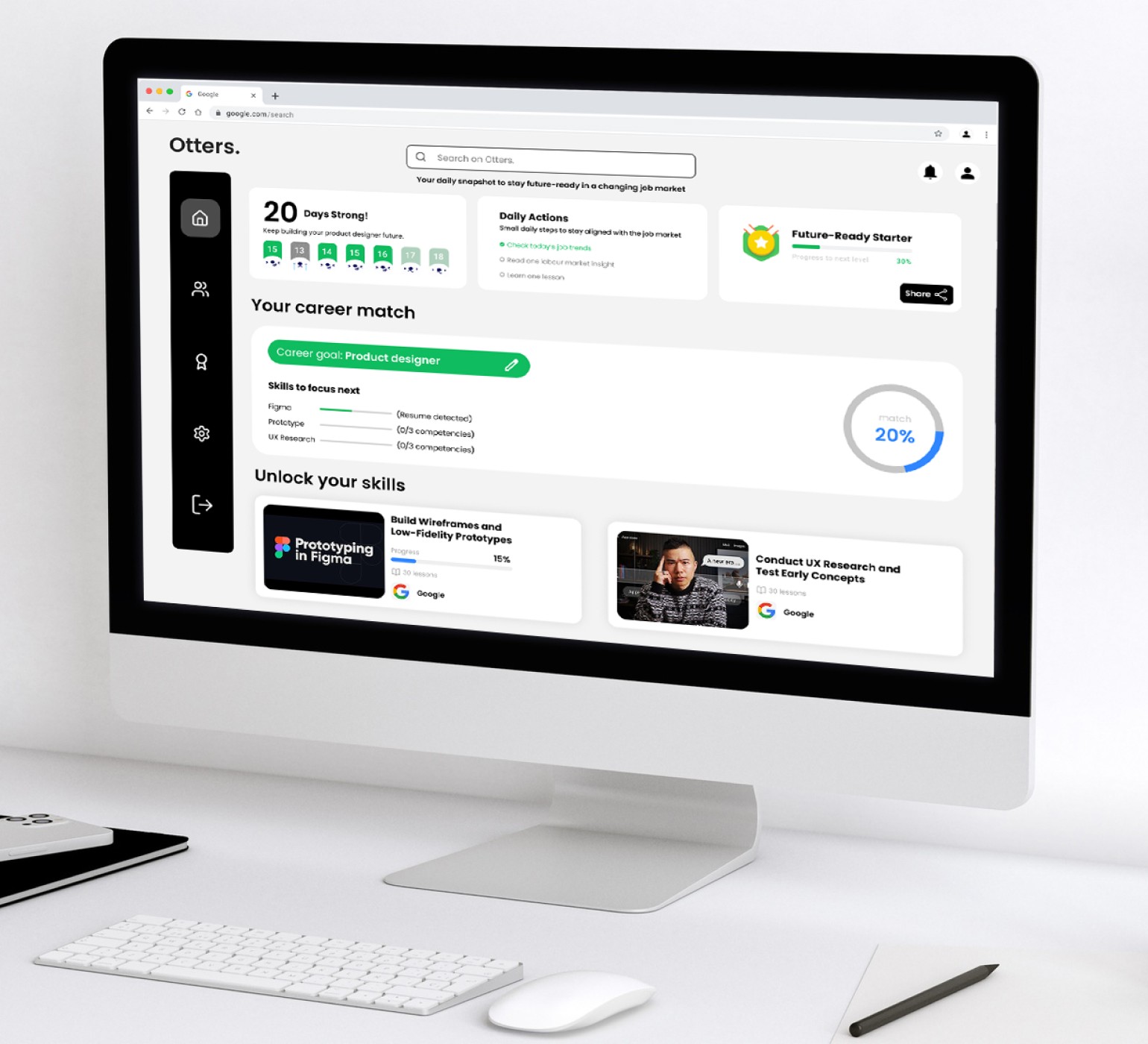
Home Dashboard


An overview of the dashboard highlighting daily progress, skill gaps, personalized recommendations, and career alignment.
An overview of the dashboard highlighting daily progress, skill gaps, personalized recommendations, and career alignment.
Recommendation


Personalized recommendations support users in starting, switching, or advancing their careers, featuring highlighted courses, curated books, short daily practice, and relevant communities for learning and networking.
Personalized recommendations support users in starting, switching, or advancing their careers, featuring highlighted courses, curated books, short daily practice, and relevant communities for learning and networking.
Skills Gap Assessment


Provides an at-a-glance overview of how users begin their learning journey.
Provides an at-a-glance overview of how users begin their learning journey.


Upload a resume or start from scratch to identify current status and next steps.
Upload a resume or start from scratch to identify current status and next steps.

An overview of users’ strengths, skills, and next areas to develop toward their career goals.
An overview of users’ strengths, skills, and next areas to develop toward their career goals.
Onboarding

Users sign up via third-party platforms or manually with name, email, and password.
Users sign up via third-party platforms or manually with name, email, and password.

To personalize users’ career journey, they’ll answer three questions about their goals, current job, and desired roles.
To personalize users’ career journey, they’ll answer three questions about their goals, current job, and desired roles.

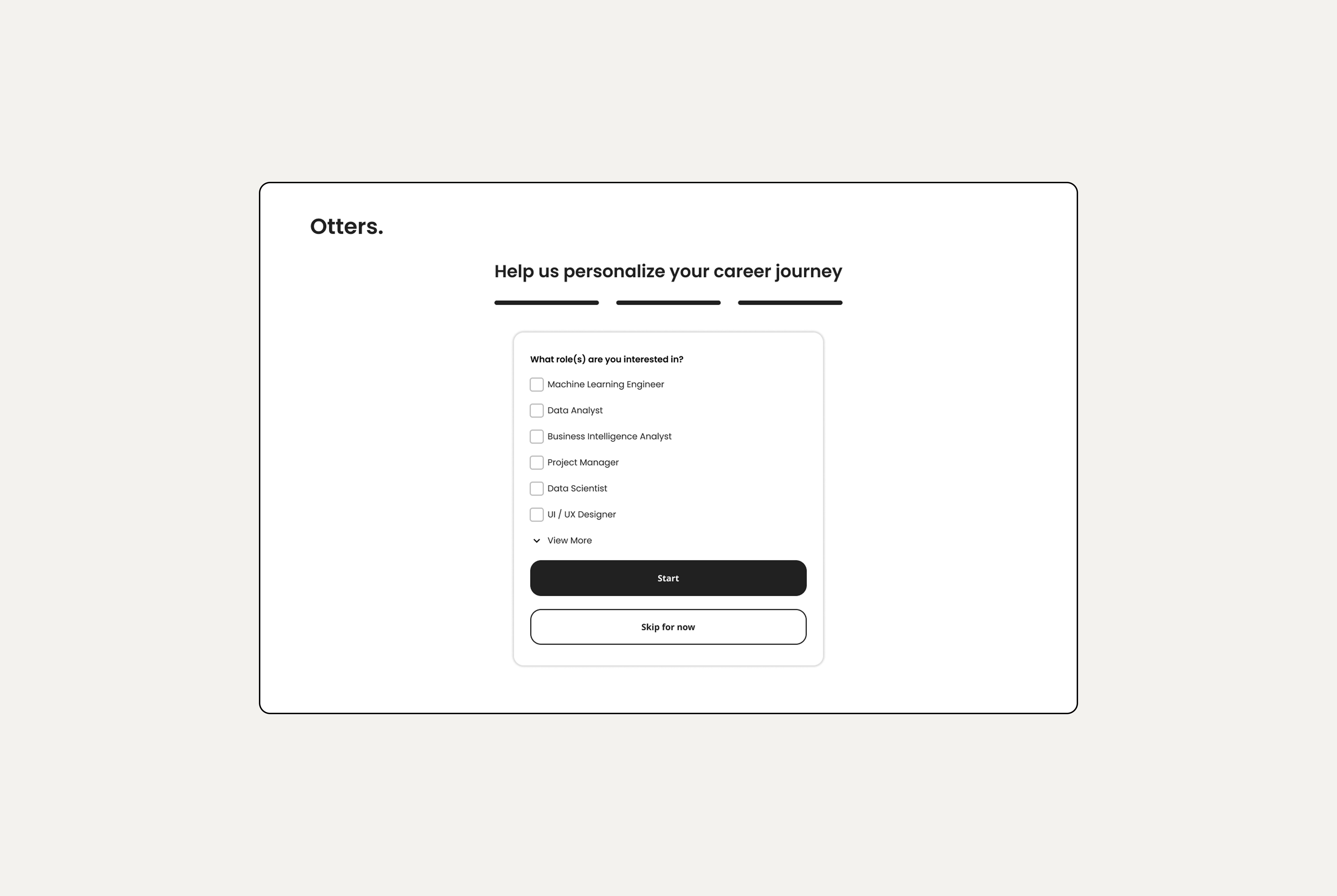
Users can skip this step for now to ensure a quick onboarding experience - the questionnaire will appear later on the home dashboard checklist for them to complete anytime.
Users can skip this step for now to ensure a quick onboarding experience - the questionnaire will appear later on the home dashboard checklist for them to complete anytime.
Behind the Scenes - Reflection and Next Steps
What I Faced and Learned
What I Faced and Learned
At the beginning of this project, I felt anxious because I had little experience with labour market data collection and analysis. Instead of trying to understand everything at once, I learned to quickly scan available data sources, define a clear scope, and focus on what was most relevant to our research goals.
Throughout the process, I continuously reminded myself that design should be grounded in user needs. During brainstorming and sketching, I repeatedly asked how each idea addressed the insights we gained from interviews, rather than designing based on assumptions.
This experience taught me how to quickly learn unfamiliar domains, work through uncertainty, and translate complex information into user-centered design decisions within a limited timeframe.
At the beginning of this project, I felt anxious because I had little experience with labour market data collection and analysis. Instead of trying to understand everything at once, I learned to quickly scan available data sources, define a clear scope, and focus on what was most relevant to our research goals.
Throughout the process, I continuously reminded myself that design should be grounded in user needs. During brainstorming and sketching, I repeatedly asked how each idea addressed the insights we gained from interviews, rather than designing based on assumptions.
This experience taught me how to quickly learn unfamiliar domains, work through uncertainty, and translate complex information into user-centered design decisions within a limited timeframe.
Next Steps - If I Could Go Further
Next Steps - If I Could Go Further
Due to time constraints, we were unable to fully incorporate salary data and long-term job vacancy forecasts into the current design. If given more time, we would prioritize integrating these data points to help users better compare career options and make more informed decisions.
We would also revisit the end-to-end experience for new and returning users, refining differences in onboarding, interface, and information depth to better support users at different stages of engagement.
Due to time constraints, we were unable to fully incorporate salary data and long-term job vacancy forecasts into the current design. If given more time, we would prioritize integrating these data points to help users better compare career options and make more informed decisions.
We would also revisit the end-to-end experience for new and returning users, refining differences in onboarding, interface, and information depth to better support users at different stages of engagement.

I’m Rowena, a UX designer with 3+ years of experience crafting high-performing websites that elevate products to the next level.
Let's Work Together!
©2026 Rowena Chen. All Rights Reserved.
I’m Rowena, a UX designer with 3+ years of experience crafting high-performing websites that elevate products to the next level.
Let's Work Together!
©2026 Rowena Chen. All Rights Reserved.
I’m Rowena, a UX designer with 3+ years of experience crafting high-performing websites that elevate products to the next level.
Let's Work Together!
©2026 Rowena Chen. All Rights Reserved.

Project
Project