Making Cake Delivery Transparent & Stress-Free
Making Cake Delivery Transparent & Stress-Free
Improved a cake shop’s delivery system by identifying service pain points and aligning the needs of customers, shops, and delivery partners.
Improved a cake shop’s delivery system by identifying service pain points and aligning the needs of customers, shops, and delivery partners.
Timeframe
May 2025 - Aug 2025
May 2025 - Aug 2025
My Role
Service Designer & UX Designer
Service Designer & UX Designer
Team
5 Service Designers: collaborated on research analysis, ideation, and prototyping
5 Service Designers: collaborated on research analysis, ideation, and prototyping
Background
The client is a cake shop offering high-quality desserts.
They operate both a physical store and an online shop, providing products such as cupcakes, customized cakes, and pre-ordered cakes.
Among the services, online orders account for 80% of the main income.
What Customers Struggled With
Customers received no confirmation after contacting the store.
Order status was unclear, neither customers nor staff could track the exact delivery time of the cakes.
These issues created uncertainty and reduced trust in the service.
Background
The client is a cake shop offering high-quality desserts.
They operate both a physical store and an online shop, providing products such as cupcakes, customized cakes, and pre-ordered cakes.
Among the services, online orders account for 80% of the main income.
What Customers Struggled With
Customers received no confirmation after contacting the store.
Order status was unclear, neither customers nor staff could track the exact delivery time of the cakes.
These issues created uncertainty and reduced trust in the service.
Our 5-Step Process: From Problems to Prototype
Our 5-Step Process: From Problems to Prototype
Step 1: Understanding the Context
Step 1: Understanding the Context

We began with a site visit, observing customer–staff interactions, both frontstage and backstage environments, while asking questions and listening carefully. Through these observations, we learned that online orders account for nearly 80% of the shop’s revenue. As a result, the owner prioritized the online ordering process over in-store service.
We began with a site visit, observing customer–staff interactions, both frontstage and backstage environments, while asking questions and listening carefully. Through these observations, we learned that online orders account for nearly 80% of the shop’s revenue. As a result, the owner prioritized the online ordering process over in-store service.
Step 2: Mapping the People & Experiences
Step 2: Mapping the People & Experiences
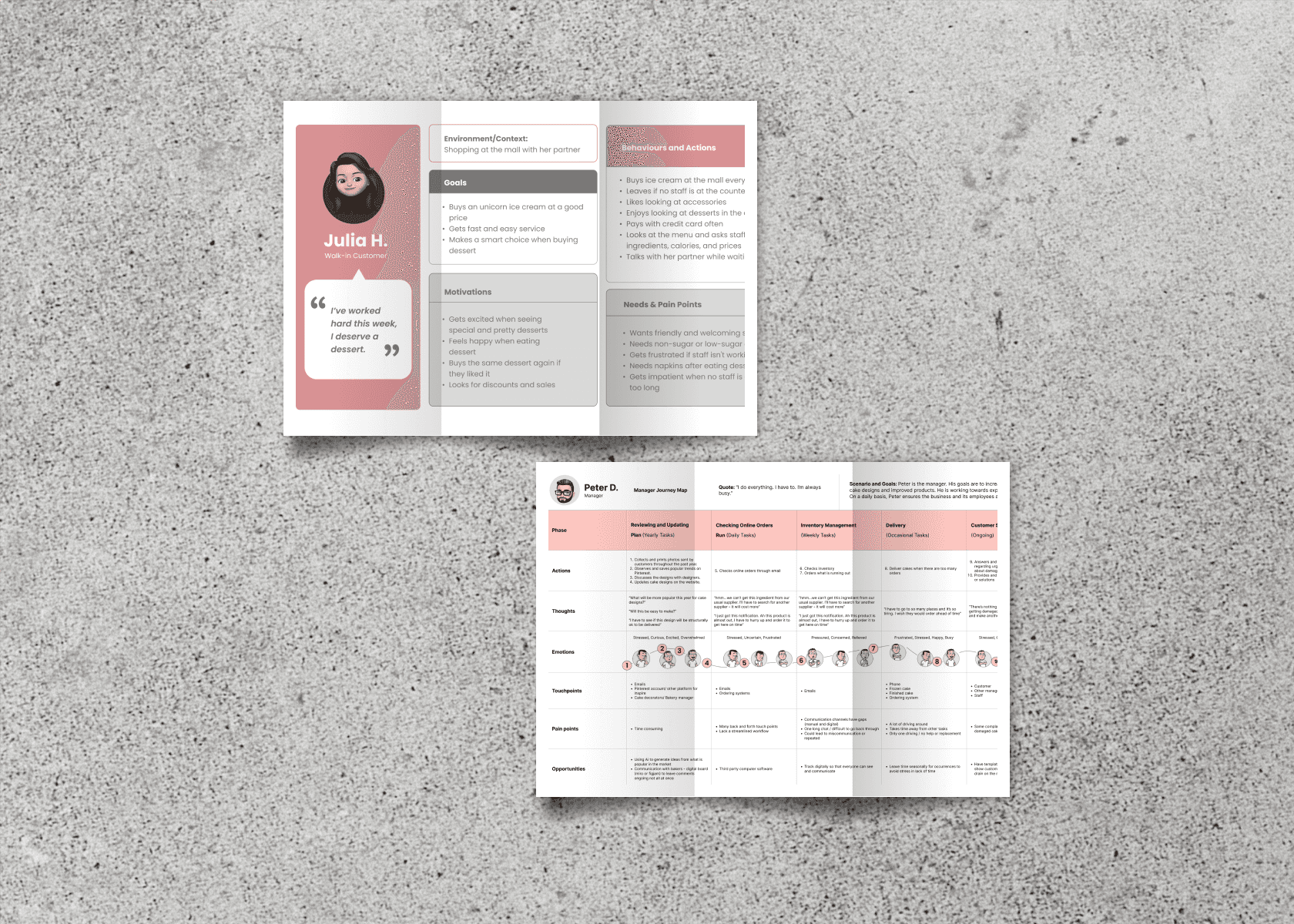
To capture the complexity of the service, we created:
To capture the complexity of the service, we created:
Personas
We represented key customer and staff types to highlight their needs and pain points.
Personas
We represented key customer and staff types to highlight their needs and pain points.


Journey Maps
We visualized the cake-ordering experience and emotions of different actors. To capture the full picture, we created separate maps for online customers, walk-in customers, staffs, and managers.
Journey Maps
We visualized the cake-ordering experience and emotions of different actors. To capture the full picture, we created separate maps for online customers, walk-in customers, staffs, and managers.


Stakeholder Maps
We identified all the actors involved, from customers to delivery drivers and managers, and mapped their relationships.
Stakeholder Maps
We identified all the actors involved, from customers to delivery drivers and managers, and mapped their relationships.

Step 3: Identifying the Main Problems
Step 3: Identifying the Main Problems
Using a Service Blueprint, we mapped both frontstage (customer-facing) and backstage processes. This revealed two critical frontstage pain points:
No real-time order tracking
Customers feel uncertain after placing an order because there is no way to track delivery status.
The root cause lies in the back-of-house system: there is no process to keep customers updated once an order is placed.
Employees are willing to help but lack the tools to provide customers with the information they need.
No confirmation after contacting the store
Customers did not receive notifications or feedback, leaving them unsure whether their request was acknowledged.
Since both issues directly affected the customer experience, we decided to focus our design efforts on addressing these challenges.
Using a Service Blueprint, we mapped both frontstage (customer-facing) and backstage processes. This revealed two critical frontstage pain points:
No real-time order tracking
Customers feel uncertain after placing an order because there is no way to track delivery status.
The root cause lies in the back-of-house system: there is no process to keep customers updated once an order is placed.
Employees are willing to help but lack the tools to provide customers with the information they need.
No confirmation after contacting the store
Customers did not receive notifications or feedback, leaving them unsure whether their request was acknowledged.
Since both issues directly affected the customer experience, we decided to focus our design efforts on addressing these challenges.

Step 4: Designing the Solution
Step 4: Designing the Solution
To address the lack of real-time order tracking and confirmation, we first decided to design three dedicated platforms, one each for store owners, drivers, and customers. This ensured that every party would have tools tailored to their specific needs.
After defining this approach, we created user flows to map how the three parties interact across the system, and developed separate information architectures that organized content in a way that supports clear navigation and communication.
To address the lack of real-time order tracking and confirmation, we first decided to design three dedicated platforms, one each for store owners, drivers, and customers. This ensured that every party would have tools tailored to their specific needs.
After defining this approach, we created user flows to map how the three parties interact across the system, and developed separate information architectures that organized content in a way that supports clear navigation and communication.


Step 5: Final Delivery - From Insights to Prototype
Step 5: Final Delivery - From Insights to Prototype
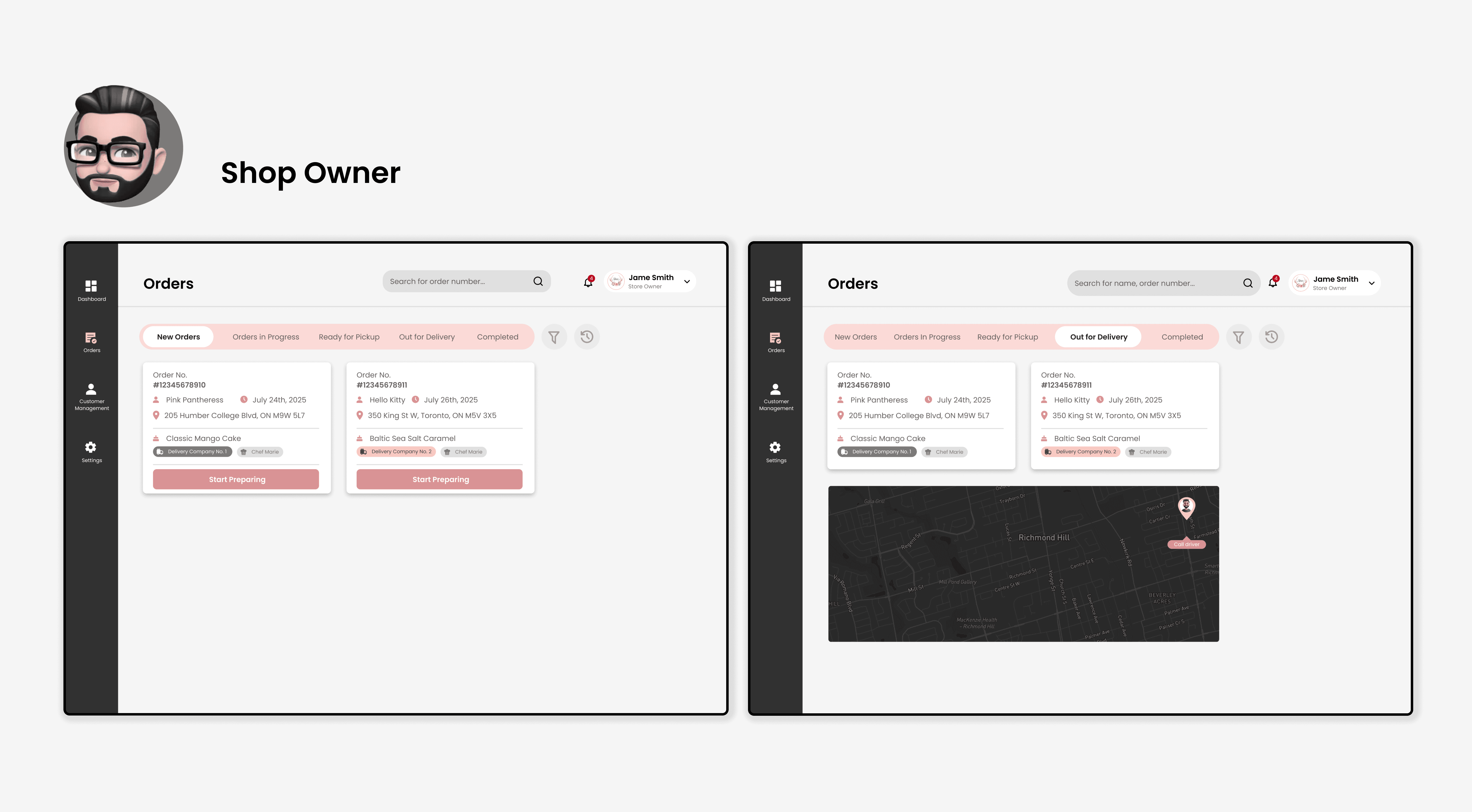
We translated our research insights into interactive prototypes that directly addressed the key pain points, helping both customers and staff trust the system and enjoy a smoother experience.
No confirmation after contacting the store → We designed an immediate feedback feature that notifies users when their message has been successfully submitted.
No real-time order tracking → We created a real-time tracking and notification system to improve communication between store owners, drivers, and customers. Each group was provided with a dedicated platform tailored to their specific needs.
We translated our research insights into interactive prototypes that directly addressed the key pain points, helping both customers and staff trust the system and enjoy a smoother experience.
No confirmation after contacting the store → We designed an immediate feedback feature that notifies users when their message has been successfully submitted.
No real-time order tracking → We created a real-time tracking and notification system to improve communication between store owners, drivers, and customers. Each group was provided with a dedicated platform tailored to their specific needs.



Expected Outcomes
Expected Outcomes
Reduce 40% of customer phone calls asking “Where is my cake?” or “When will it be delivered?”
Increase customer satisfaction by 20%
Reduce 40% of customer phone calls asking “Where is my cake?” or “When will it be delivered?”
Increase customer satisfaction by 20%
40%
Reduction in Customer Inquiry Calls
Improved Onboarding Process
20%
Increase in Customer Satisfaction
Increase in Customer Satisfaction
Behind the Scenes: Reflection and Next Steps
Behind the Scenes: Reflection and Next Steps
What I Faced and Learned
What I Faced and Learned
What I Faced and Learned
We uncovered around ten issues of varying scale, and prioritizing which ones to address first was a challenge. By focusing on what mattered most to the owner, online orders, which accounted for 80% of revenue, and using the service blueprint to highlight pain points closest to the customer, we selected the most impactful problems to solve.
I also learned the importance of presenting two types of solutions to clients: one that can be implemented immediately, and another that serves as a long-term direction for future growth.
We uncovered around ten issues of varying scale, and prioritizing which ones to address first was a challenge. By focusing on what mattered most to the owner, online orders, which accounted for 80% of revenue, and using the service blueprint to highlight pain points closest to the customer, we selected the most impactful problems to solve.
I also learned the importance of presenting two types of solutions to clients: one that can be implemented immediately, and another that serves as a long-term direction for future growth.
Next Steps - If I Could Go Further
Next Steps - If I Could Go Further
During our interview with the manager, we discovered another challenge: last-minute ordering, especially around Christmas, when chefs often had to work overtime until 3 a.m. To explore solutions for this issue, I would like to conduct a co-creation workshop with the staff and managers to generate ideas and design strategies together.
During our interview with the manager, we discovered another challenge: last-minute ordering, especially around Christmas, when chefs often had to work overtime until 3 a.m. To explore solutions for this issue, I would like to conduct a co-creation workshop with the staff and managers to generate ideas and design strategies together.


I’m Rowena, a UX designer with 3+ years of experience crafting high-performing websites that elevate products to the next level.
Let's Work Together!
©2026 Rowena Chen. All Rights Reserved.
I’m Rowena, a UX designer with 3+ years of experience crafting high-performing websites that elevate products to the next level.
Let's Work Together!
©2026 Rowena Chen. All Rights Reserved.
I’m Rowena, a UX designer with 3+ years of experience crafting high-performing websites that elevate products to the next level.
Let's Work Together!
©2026 Rowena Chen. All Rights Reserved.

Project
Project